Optimization is usually drawn as a climb. There is a landscape, each candidate has a height, and better candidates sit above worse ones.
Many real systems have no single height. An industrial process may need output, safety, energy use, maintenance burden, and environmental impact to move together. A trading system may care about return, drawdown, turnover, capacity, latency, and the conditions under which any advantage appears. Combining these into one score requires preferences that may change with the decision.
Dominance
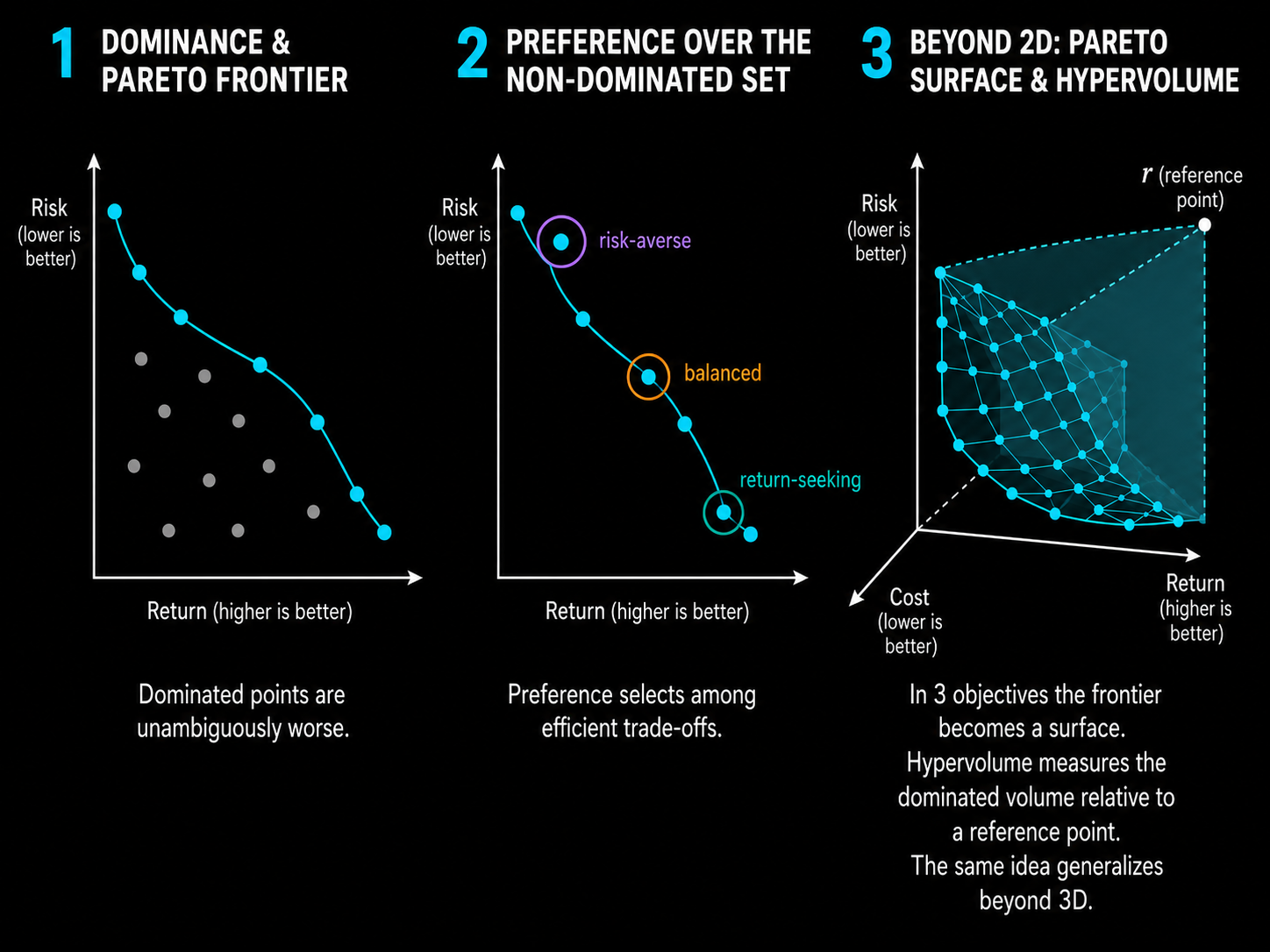
Some comparisons require no preference model. If one candidate produces more while consuming less, or earns a higher return with lower risk under the same conditions, it dominates the other. The inferior candidate offers no compensating advantage.
The interesting cases begin when the advantages split. One strategy returns more and draws down more. Another trades less but adapts slowly. A third sacrifices upside for stability when conditions change. None can be removed without losing something.
The frontier
The candidates left after removing every dominated alternative form the Pareto set. Their objective values form the Pareto frontier: a curve with two objectives, a surface with three, and a higher-dimensional boundary beyond that.
Candidates can be model parameters, portfolio weights, programs, designs, or experimental methods. They belong to the same frontier when they have been evaluated under comparable conditions. The frontier records the trade-offs that are currently attainable.
A utility function can choose one point. So can a budget, a risk limit, a latency constraint, or the fee structure of a particular venue. The choice may change while the underlying evidence remains the same. A policy rejected under one operating envelope can become efficient under another.
Measures such as hypervolume evaluate the set itself by asking how much objective space it dominates relative to a reference point. This matters when the aim is to improve the available choices rather than crown a single winner.
Lenses
A frontier becomes an interface between search and commitment. Search supplies alternatives and evidence. A lens supplies the priorities of the present decision.
That lens may be simple: exclude candidates above a drawdown limit, then maximize return. It may also depend on recent conditions, uncertainty, execution costs, or the need to learn something from the next experiment. The same population can support several saved views without rewriting its history around the latest preference.
This is useful for human judgment and for agents. An agent can work with more dimensions than a person can comfortably plot, while the resulting selection still points back to the evidence and constraints that produced it.
Prematurely reducing everything to one score erases this structure. It hides useful specialists, makes changing preferences look like contradictory evaluations, and turns a population into a leaderboard.
Better is often the boundary of what has been learned so far. The final choice belongs to a particular moment; the frontier should survive it.